

With new employment laws coming into effect this year, you’d think employers have enough on their plates without the added burden of poor mental health. Employee wellbeing does need to be addressed though. Once an individual stops working due to ill-health, their chances of returning to work diminish significantly. This not only impacts the individual’s quality of life but also places a financial strain on welfare systems. The Government is looking for employers to step up.
People with poor mental health in the workplace are genuinely suffering, and the prevalence of these conditions is increasing. However, with the aim of keeping as many people in work as possible, it’s important to start differentiating between less severe symptoms and more serious clinical conditions. The seriousness of each mental health condition should be understood, assessed and supported accordingly, and particularly for younger people in the 16-34 age range.
Overdiagnosis of mental illness
A staggering 2.7m 16 to 34 year olds have a work-limiting health condition compared to 2.3m 35-49 year olds. The overdiagnosis of mental illness is one of the main reasons that more young people in Britain are deemed to be too sick to work than ever before. These stark figures underline the high stakes of intervening early. That means that it falls to employers to actively understand and support young people and keep them in work.
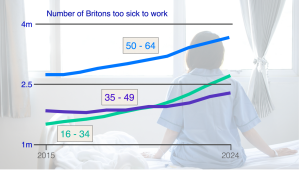
Source: Department of Work and Pensions
These DWP figures were published alongside a review that comes at a time when Liz Kendall, Work and Pensions Secretary, is announcing £4.8bn cuts in welfare and disability benefits.
Wes Streeting, the Health Secretary who’s also looking for savings in his department, has added his own weight to the conversation by suggesting that mental health conditions may be over-diagnosed.
Sir Charlie Mayfield, the former chairman of the John Lewis partnership, has been leading the DWP review that’s been looking into economic inactivity. The ultimate aim is to support people with long-term disabilities back into work, as well as helping others to remain in their jobs.

Liz Kendall and Sir Charlie Mayfield
Sir Charlie has warned of “over-medicalising” mental illness. In an interview with The Telegraph last week he said:
“There probably is some over-medicalisation of early-stage mental health issues. Part of the reason for that is there’s nowhere to go other than to a medical doctor when somebody starts to experience issues. We’re seeing this over-medicalisation because we lack alternative treatment pathways for people at early stages of when they’re showing mental health challenges.”
“What is very clear is that it’s better to prevent this issue from happening than to try and cure it after it happened. The only people really who can play a particularly strong role in that are actually employers.”
Why employers must step up
It’s easy to sympathise with employers who are having to cope with new employment laws, the higher National Living Wage, and increased NI and from April. On top of all of that, they are also being asked to step up their support for mental health in their workplaces.
However, as Sir Charlie said: “Employers have a critical role in preventing the initial onset of work-limiting mental health conditions by fostering a supportive environment and providing access to resources and treatment pathways.”
This does make sense. After all, who else could shape the working environment and ensure that staff are properly supported? The key then is for employers to implement a mental health and wellbeing strategy that focusses primarily on prevention, and that isn’t too onerous or expensive to operate.
How does Gallantium help?
The Gallantium platform very much does focus on prevention rather than cure. It provides ready access to education resources through a variety of content formats, and it proactively drives user engagement.
It’s still a good idea to encourage mental health champions and first aiders for the human touch, but Gallantium offers completely anonymous access 24 hours a day. It helps the hard-pressed employer by doing much of the initial outreach, keeping users informed, and signposting to specialist services and treatment pathways where needed.
Summary
Whilst cases of poor mental health continue to rise, and with them the cost to employers as well as the welfare budget, it’s perhaps time to take a fresh look at what we define and categorise as poor mental health.
Some conditions are serious, long term, and need medical referral so that the best clinical support can be provided.
Other cases though can be re-interpreted as the more common ups and downs of working life. If they are properly understood they can be treated in the workplace through training, enlightened and compassionate management, and by individuals themselves.